Density Calibration: Matching Wax to Fluid for Correct Motion
Why Density Difference Is the Whole Game
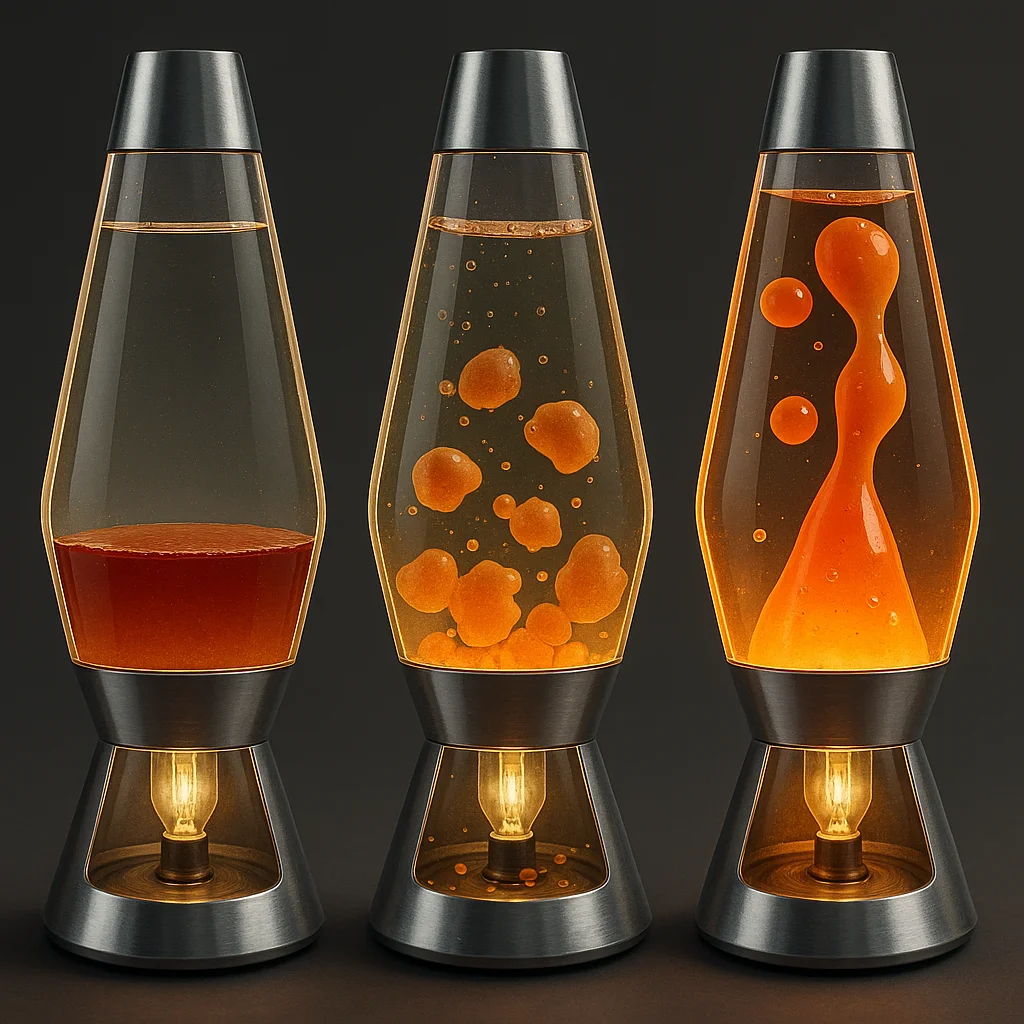
Lava lamp motion depends on a single governing principle: the wax and the surrounding fluid must have densities close enough to each other that small thermal changes tip the balance in alternating directions. At room temperature, the wax sits at the bottom because it is marginally denser than the fluid. When the bulb heats the wax to its working temperature, thermal expansion reduces the wax’s density below that of the fluid, and it rises. As it cools near the top of the globe, it contracts, becomes denser again, and sinks. The entire choreography follows from that narrow density differential — typically 0.003 to 0.010 g/cm³ between solid wax and fluid at operating temperature.
If the differential is too wide, the wax either stays anchored at the bottom throughout operation or floats permanently at the surface, neither of which produces motion. If the differential is too narrow, the wax becomes mechanically unstable: it may form a single sluggish mass that barely separates, or it may stay in continuous suspension rather than cycling cleanly.
Reading the Numbers: A Worked Density Calculation
Consider a standard Mathmos Astro wax compound with a solid density of approximately 0.960 g/cm³ at 20 °C. The translucent fluid in the same unit — a water-surfactant mixture — sits at roughly 0.961 g/cm³ at 20 °C. The wax is therefore just below the fluid density, which is why it rests at the base rather than floating immediately.
At operating temperature (typically 60–65 °C for this class of lamp), the wax melts and expands. A volumetric expansion of approximately 8–10% is characteristic of paraffin-based compounds in this formulation range. Applying a conservative 8% expansion to the solid volume:
New density = 0.960 ÷ 1.08 ≈ 0.889 g/cm³
The fluid, being largely aqueous, expands far less — perhaps 1.5–2% over the same temperature range:
Fluid density at 65 °C ≈ 0.961 ÷ 1.017 ≈ 0.945 g/cm³
The molten wax at 0.889 g/cm³ is now meaningfully lighter than the hot fluid at 0.945 g/cm³, which accounts for the buoyancy that drives the wax upward. The margin here — approximately 0.056 g/cm³ — is sufficient for vigorous motion without the wax becoming so buoyant that it refuses to re-sink when cooled.
These figures illustrate why recalibrating wax after a rewax procedure requires measuring densities at multiple temperatures, not just at room temperature. A compound that appears correctly matched cold can be badly mismatched hot, and vice versa.
Calibration in Practice: Adjusting the Wax Density
When a freshly mixed wax compound is too dense — sinking correctly when cold but refusing to rise under heat — the standard corrective approach is to reduce its density by blending in a lower-density wax fraction, most commonly a microcrystalline wax with a density in the 0.900–0.920 g/cm³ range. The adjustment is incremental: small additions, followed by testing at operating temperature before any further change.
The inverse problem, wax that is too light and floats perpetually, calls for the addition of a denser component or, in some cases, a density additive. This is comparable in logic to adjusting a hydrometer reference liquid for brewing: the principle is the same iterative balancing toward a known target value, using measured additions rather than approximation.
The full reference values for wax and fluid densities across relevant temperature ranges — including figures specific to Mathmos Astro, Astrobaby, and Telstar formulations — are collected in the Reference Tables. Readers working through a rewax procedure will also find the thermal expansion data on the Thermal Behaviour page essential context for understanding why these numbers shift so significantly between cold and operating conditions.