Common Wax Failure Modes in Mathmos Lamps: Causes Explained
Why Wax Behaviour Degrades Over Time
Mathmos lamps use a carefully balanced two-phase system: a wax compound and an aqueous fluid whose densities are matched to within a very narrow tolerance at the lamp’s operating temperature. When that balance is intact, the wax melts cleanly from the base, rises, cools, and sinks in the familiar repeating cycle. When it is not, the failure is rarely subtle — and the cause is almost never random.
Most wax failure in Mathmos units traces back to one of four distinct mechanisms: clouding of the fluid, clumping or coalescence of the wax, adhesion to the glass, or permanent deformation of the wax mass. Each has a different origin, and each points to a different underlying disruption of the thermal or chemical equilibrium.
Fluid Clouding and Emulsification
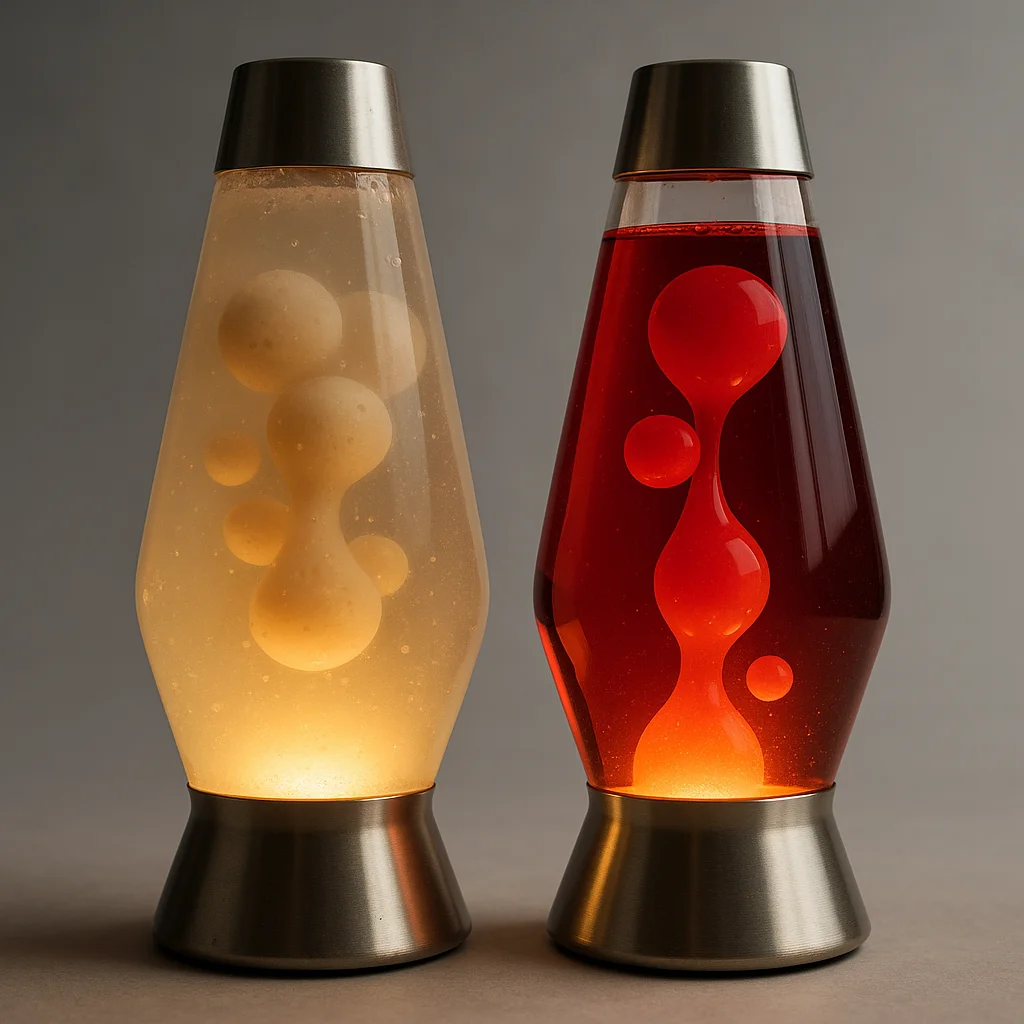
Clouding is among the most visible failure modes and among the most misdiagnosed. The translucent fluid turns milky or hazy, and the wax blobs become difficult to see clearly. The immediate cause is emulsification — the surfactant fraction of the wax compound has migrated partially into the fluid phase, forming a stable oil-in-water or water-in-oil dispersion that scatters light.
This typically follows thermal overstress. Running a lamp beyond its rated operating temperature, or allowing it to cycle repeatedly through extreme heating and cooling, degrades the interfacial film that keeps the two phases separated. The surfactant molecules — which in a correctly functioning lamp exist primarily at the wax-fluid boundary — redistribute. Once emulsified, the fluid does not clear spontaneously; the change is effectively irreversible under normal operating conditions.
A secondary cause of clouding is contamination: minerals from hard water, residue from handling, or degraded fluid components can all nucleate droplet formation. This is why Mathmos specifically uses deionised water in its fluid formulations, as described on the wax compound composition page.
Wax Clumping and Failure to Separate
When the wax mass fails to separate into discrete blobs and instead aggregates into a single large mound or several fused chunks, the cause is almost always a density calibration drift. As detailed on the density calibration page, correct motion depends on the wax being marginally denser than the fluid at rest and marginally less dense when fully molten. A shift of as little as 0.002 g/cm³ in either direction can prevent clean separation.
Clumping itself accelerates this drift. A large unified wax mass has a smaller surface-area-to-volume ratio than multiple smaller blobs, which means heat transfer into the wax interior slows, the wax centre never fully melts, and the partially solid core acts as a nucleus around which additional wax coalesces. The failure compounds itself.
Over-lighting — running the lamp at higher wattage than specified — can cause the wax to melt too completely, losing the small density differential needed for controlled convection. Under-lighting has the opposite effect: the wax softens but never fully melts, producing the characteristic flat-bottomed dome that refuses to lift from the base.
Wax Adhesion and Surface Sticking
Wax that adheres persistently to the glass vessel wall is exhibiting a polarity mismatch at the glass-wax interface. The glass surface is hydrophilic; under normal conditions the aqueous fluid wets it preferentially, forming a thin film that prevents wax contact. When the surfactant balance is disrupted — again, usually through thermal degradation or contamination — the wax can displace this film and bond directly to the silica surface.
Prolonged cold storage, UV exposure, and certain cleaning agents applied to the exterior of the glass can all reduce the effectiveness of this protective wetting layer.
Reading Failure as Diagnostic Evidence
Each of these failure modes leaves a characteristic signature, and identifying which is present is the first step toward understanding whether recovery is possible. The cures and corrections page examines what can and cannot be reversed, while the reference tables provide the density and melting-point values needed to assess whether a given wax compound is still within specification.