Thermal Behaviour of Lava Lamp Wax: Melting, Expansion, and Convection
The Role of Heat in Wax Phase Transition
Lava lamp wax begins as a solid mass resting on the floor of the globe at room temperature. Its density at this stage is marginally greater than that of the surrounding fluid — typically by 0.002 to 0.008 g/cm³, depending on the specific compound formulation. When the lamp is switched on, the resistive heating element beneath the globe raises the temperature of the fluid in contact with the base, and that heat transfers conductively into the wax.
The critical transition occurs at the wax’s melting point, which in most Mathmos-type formulations falls between 54 °C and 62 °C. This is not a sharp boundary in the way that pure crystalline solids melt; the wax compound is a mixture of components — typically paraffin-based hydrocarbons blended with additives that modify both the melting range and the final working density. The result is a softening curve rather than a single transition temperature. The outer surface of the wax mass begins to liquefy before the interior does, and the wax passes through a semi-plastic intermediate state during which it deforms under its own weight before achieving full fluidity.
Volumetric Expansion and Its Consequences for Density
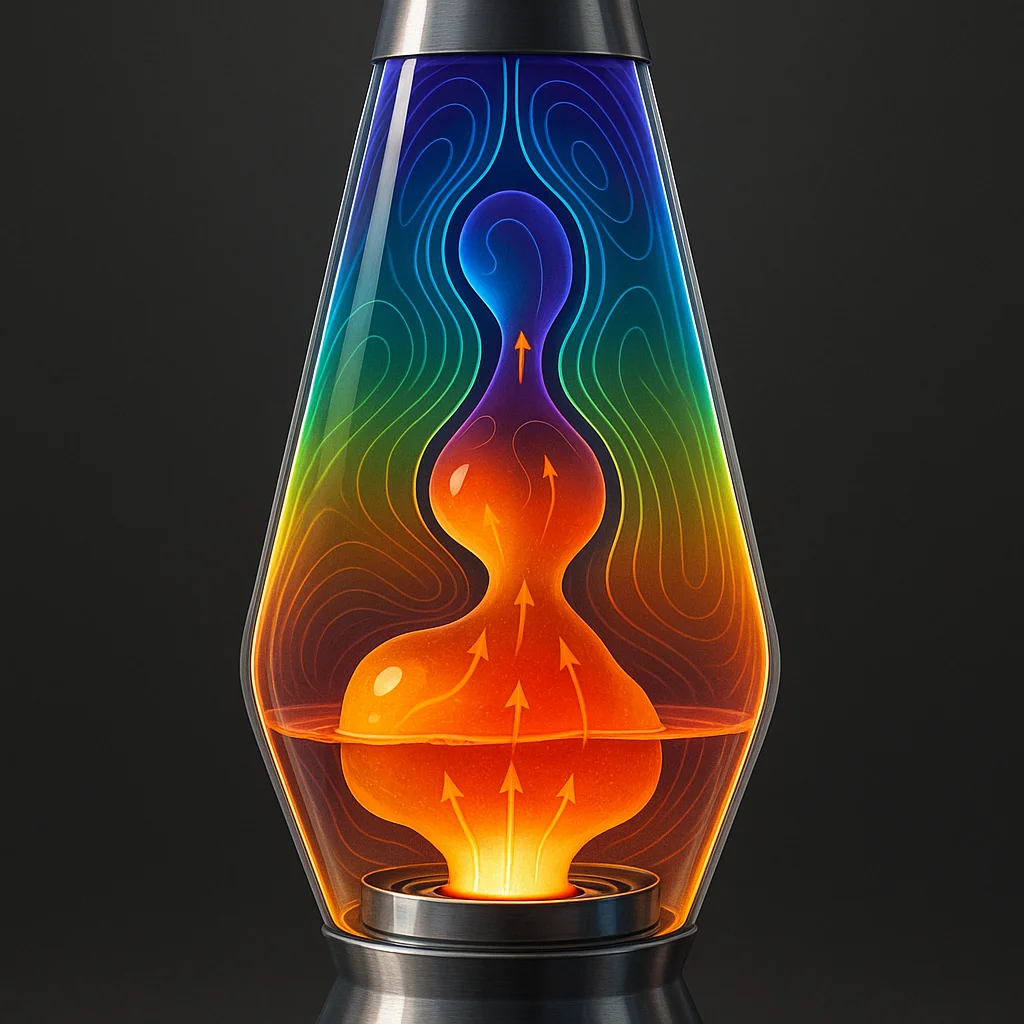
The mechanism by which wax achieves liftoff is a direct consequence of thermal expansion. As the wax melts and its temperature rises toward operating range — typically 60 °C to 70 °C inside a functioning globe — its volume increases. The coefficient of volumetric thermal expansion for paraffin-based waxes is approximately 0.00080 to 0.00090 per °C, substantially higher than that of water (0.000214 per °C at 60 °C) and higher still than the water-and-surfactant fluid used in most commercial lamps.
The implication here is precise: because the wax expands more rapidly with temperature than the surrounding fluid does, a wax that sits slightly denser than the fluid at room temperature will, at operating temperature, have expanded enough to bring its density below that of the fluid. At that crossover point, buoyancy inverts and the molten wax rises. The calibration of this crossover — ensuring it occurs within the lamp’s intended operating temperature range and not at an extreme — is the central challenge of wax compound formulation, covered in detail on the density calibration page.
Convective Flow: What Drives the Motion
Once molten wax blobs reach the cooler upper region of the globe, heat loss to the glass and surrounding air reduces their temperature. The wax contracts, its density rises back above that of the fluid, and it sinks. Near the base, it encounters heat again, re-melts if it has partially solidified, re-expands, and rises once more. This cycle is the convective engine that produces the characteristic lava lamp motion.
The behaviour is not purely driven by gross density reversal, however. Fluid dynamics within the globe — including the viscosity of both the wax and the continuous fluid phase, surface tension at the wax-fluid interface, and the shape of blobs as they deform during ascent and descent — all modulate the visual result. Wax of higher viscosity tends to produce slower, more rounded blobs; lower-viscosity wax produces faster, more irregular shapes that may break and coalesce more readily.
The surfactant content of the fluid plays a significant role here: it lowers interfacial tension between wax and fluid, allowing blobs to separate and merge rather than forming a single persistent mass. Changes to surfactant concentration are among the more common causes of degraded motion over a lamp’s operational life.
For readers interested in the compositional details that underpin these physical behaviours, the wax compound composition page examines the specific classes of hydrocarbons and additives involved. Where thermal behaviour breaks down into visible failure, the common wax failure modes page traces each symptom back to its physical cause.